


Chile is a country of startling contrasts and extreme beauty, with attractions ranging from the towering volcanic peaks of the Andes to the ancient forests of the Lake District. There are a multitude of very good parks here, and plenty of opportunities for fine adventure travel. Chile is justly famous as the location of Torres del Paine, considered by many to be the finest nature travel destinations in all of South America.
Location, Geography Climate
For anyone who has ever been fascinated by geography, the long, impossibly thin line of Chile has always produced a tiny moment of astonishment. Chile stretches over 4,300 km (2,700 mi) along the southwestern coast of South America, a distance roughly the same as that from San Francisco to New York, or Edinburgh to Baghdad. At the same time, its width never exceeds 240 km (150 mi), making the country more than eighteen times longer than its widest point.
The most obvious factor in Chile's remarkable slenderness is the massive, virtually impassable wall of the Andes, a mountain range that is still rising and that contains more than fifty active volcanic peaks. The western border is of course the Pacific Ocean, but it is a misconception to picture Chile as nothing more than the steep western slope of the Andean peaks. All along its length Chile is marked by a narrow depression between the mountains and the sea. To the north the land rises and becomes more arid, until one reaches the forbidding Atacama Desert, one of the most inhospitable regions on earth. To the south just the opposite transformation takes place: the land falls away, and the region between mountains and ocean fades into the baffling archipelagic maze that terminates in Chilean Patagonia. Chile's southern extremity is marked by Cape Horn, a treacherous headland surrounded by almost continuously storm-tossed seas and passable only through the foggy stillness of the Strait of Magellan.
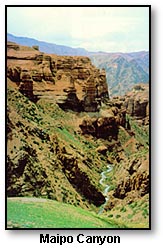
In the center of the country, however, is a long and expansive river valley, a five hundred mile corridor occupied in the north by vineyards and great farms and in the south by primeval forests and enchanting lakes. Santiago, the capital, anchors the northern and more prosperous section of the central valley. The lush Lake District to the south, however, is the homeland of Chile's indigenous peoples, the Araucanians.
Also part of Chile are two notable Pacific possessions-the Juan Fernandez Islands and the famous Easter Island, both of which are administered as national parks. The Juan Fernandez islands are located about 670 km off the Chilean coast, while Easter Island is situated 3700 km distant.
Chile's climate is as diverse as its geography. Aside from the obviously extreme climatic conditions of the Andes an the Atacama, however, the country enjoys a comfortable temperate climate.
The Chilean Coast Range
Like the Andes, the coastal range becomes progressively lower with increasing latitude. The range begins at Morro de Arica in the north and reaches its highest point, of 3114 m, in Sierra Vicuña Mackenna in the Antofagasta Region. Between Copiapó and Aconcagua rivers, in the so-called Norte Chico region, the range fuses with the Andes. Just north of Santiago the range separates from the Andes but comes close to it again near Paine, a southern suburb of Santiago, and San Fernando. From Santiago south the range loses height until reaching the Bío-Bío River, beyond which the Nahuelbuta range emerges which reaches about 1500 m in its central parts. South of Nahuelbuta Range, in the Araucanía Region, the coastal range is replaced by a flatland area. South of Toltén River the range rises again as the Cordillera de Mahuidanchi. Beyond the heights of Corral this range changes into Cordillera Pelada. From Chacao Channel south the range is penetrated by the sea creating islands and peninsulas. Chiloé Island, the largest of these, has two ranges: Piuchén Range from Chacao Channel to Cucao Lake and Pirulil Range in the southern half. South of Chiloé the portions of the range above sea level form the Guaitecas and the Chonos Archipelagos. The southern extreme of the range forms the Taitao Peninsula and its sub-peninsula Tres Montes.
Want to travel to Chile? Get cheap flights there today!


0 comments:
Post a Comment